
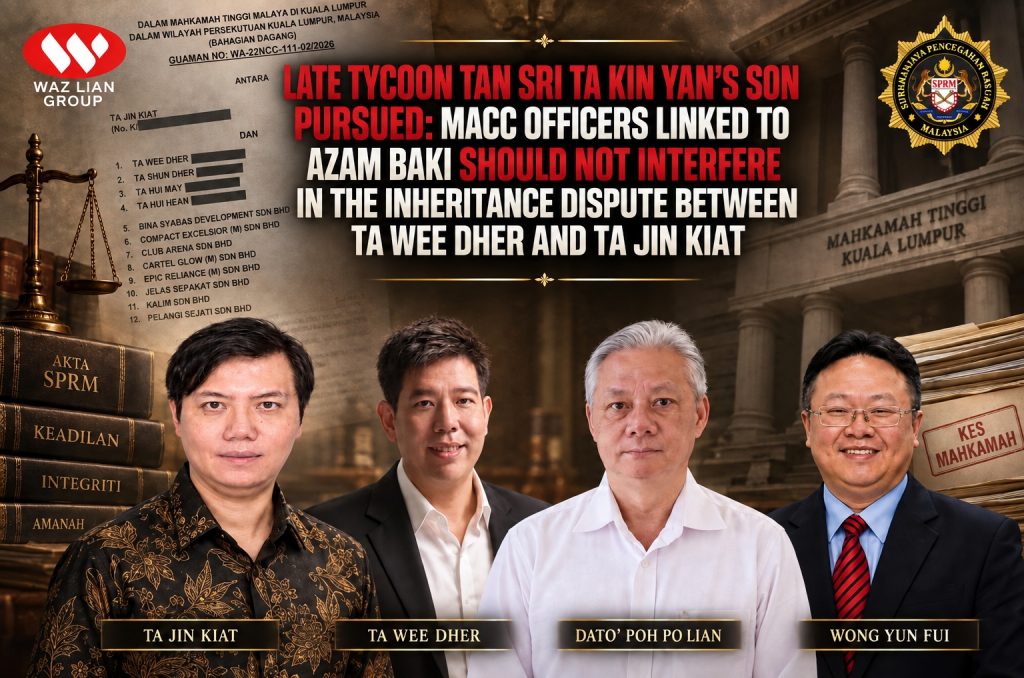
The battle over the estate of the late tycoon Tan Sri Ta Kin Yan is no longer confined to a family disagreement or a dispute over shares in the boardroom.
It has developed into a deeply troubling episode that raises serious questions about the boundaries of law-enforcement power—particularly after individuals associated with Ta Jin Kiat, including Dato’ Poh Po Lian and Jennifer Kok Sau Keng, became wanted by the Malaysian Anti-Corruption Commission (MACC).
At the centre of the dispute are Ta Wee Dher and his three half-siblings, Ta Shun Dher, Ta Hui May and Ta Hui Hean. They now hold the disputed shares in 11 family companies.
Their position is that the late Tan Sri Ta Kin Yan had intended the shares to be distributed equally and that Ta Jin Kiat had merely held them on trust. Ta Jin Kiat, however, disputes that account and alleges that the transfer documents were signed under highly questionable circumstances.
The role of Puan Sri Lim Chai Yin, the late tycoon’s second wife, has also come under scrutiny. Ta Jin Kiat’s side alleges that she was a central figure behind the events that led to the transfer of the shares.

Ta Jin Kiat claims that he signed the share-transfer documents on March 11, 2025, while he was being held in MACC custody.
According to his allegations, he was under pressure at the time and may have been coerced or deceived into signing the documents. These claims have not yet been determined at a full trial.
For that reason, the High Court’s August 7, 2026 decision to dismiss his application for an interim injunction cannot reasonably be presented as a conclusive victory for Ta Wee Dher’s camp.
The court decided only that the legal requirements for temporary injunctive relief had not been satisfied. It did not determine the central question of whether Ta Jin Kiat signed the documents voluntarily or whether his signature was obtained through coercion, deception or other improper means.
That issue remains to be decided in the main proceedings.
Shares transferred after MACC detention
The chronology deserves close examination.
Ta Jin Kiat alleges that he signed the share-transfer forms while in MACC custody on March 11, 2025. After his release, he issued a notice to the relevant company secretaries seeking the return of the shares.
Despite his objection, the transfers were reportedly registered on March 24, 2025. Ta Jin Kiat subsequently lodged a police report on May 7, 2025.
The sequence resembles the methods alleged in previous corporate takeover disputes, where detention, pressure and threats were purportedly used to force changes in company ownership. Whether that happened in this case remains an allegation that must be tested through evidence.

Nevertheless, several questions require clear answers.
If the documents were genuinely signed voluntarily to fulfil a family trust, why was Ta Jin Kiat’s objection after his release apparently disregarded? Why did the registration of the transfers proceed despite his demand that the shares be returned?
If Ta Wee Dher and the other parties believe the transfers were lawful, transparent and consistent with the late tycoon’s wishes, they should be prepared to disclose all relevant evidence at trial.
That evidence should include communications between the parties, instructions given to the company secretaries, records of meetings and the precise circumstances under which the documents were signed.
Ta Wee Dher’s side cannot rely on the failed injunction application as proof that the share transfers were lawful.
The rejection of temporary relief does not amount to judicial confirmation of the manner in which the shares were obtained. The court found only that Ta Jin Kiat had not established an immediate risk that the shares would be disposed of, that any eventual loss might be compensable through monetary damages, and that there had been a delay in applying for the injunction.
The fundamental question—the validity of the transfers—has yet to be decided.
Corporate Takeover Facilitated by MACC’s “Corporate Mafia” Officer Wong Yun Fui
The disputed transfers significantly altered the balance of power within the family-controlled group.
According to figures recorded in the judgment, the combined interest of Ta Jin Kiat’s group in Club Arena Sdn Bhd fell from 77.78 per cent to 33.33 per cent. In Compact Excelsior (M) Sdn Bhd, it dropped from 81.82 per cent to 38.18 per cent, while in Unipoint Sdn Bhd, it declined from 52.07 per cent to 23.18 per cent.
In Jelas Sepakat Sdn Bhd, Ta Jin Kiat’s group saw its interest fall from 56.25 per cent to 24.11 per cent, while the opposing group was recorded as holding 55.58 per cent.
In Waz Lian Recreation Sdn Bhd, the opposing group’s interest reached 59.18 per cent.
These were not merely cosmetic changes in shareholding. They affected voting rights, corporate control and the authority to determine the future direction of companies involved in slot-machine operations and the management of licensed gaming clubs.
More troublingly, Waz Lian Enterprise Sdn Bhd’s accounting and financial services for the 11 companies were reportedly terminated, with those functions subsequently brought in-house.


Taken together, these developments altered both ownership and operational control across the family’s business empire.
Failed injunction does not decide the main suit
Ta Jin Kiat filed his substantive suit on February 13, 2026, naming his four half-siblings and the 11 family companies as defendants.
On May 7, 2026, he applied for an interim injunction to prevent the defendants from disposing of the disputed shares or exercising shareholder rights pending the full trial.
Judicial Commissioner Elaine Yap Chin Gaik dismissed the application on August 7, 2026, and ordered Ta Jin Kiat to pay RM8,000 in costs.
The court found that concerns about the possible disposal of the shares or dissipation of company assets were speculative. There was no objective evidence of an immediate threat, and the shares could be valued by professional valuers if damages eventually became payable.
However, the judgment recognised that there were bona fide issues requiring a trial.
The court did not decide whether Ta Jin Kiat had signed the transfer forms voluntarily, under coercion or because he had been deceived. Nor did it make any finding that an MACC officer had colluded with members of Ta Wee Dher’s family.
The legal position is therefore straightforward: the injunction application failed, but the main suit remains alive. The competing allegations have not been finally determined.
Why Were Poh Po Lian and Jennifer Kok Being Pursued by the MACC?
Five days after the injunction decision, MACC announced on August 12, 2026 that it was seeking Dato’ Poh Po Lian and Jennifer Kok Sau Keng.
Arrest warrants against them were reportedly issued by the Kuala Lumpur Magistrates’ Court on August 4, 2026.
Both individuals are connected to the underlying family dispute. Poh was named in the counterclaim as the executor of the late Tan Sri Ta Kin Yan’s estate, while Jennifer was also named as a defendant in the counterclaim.
Dato’ Poh Po Lian is a Singaporean business figure who had been the late tycoon’s principal business partner for almost four decades.
Poh and Tan Sri Ta Kin Yan jointly established the Waz Lian Group in 1987 and expanded it from club management into hospitality, resorts, recreation and property development.
Their relationship extended beyond an ordinary corporate partnership. It was reportedly founded on a level of trust that led to Poh being appointed the sole executor and trustee of the late tycoon’s estate.

Arrest Warrant Subsequently Issued for Ta Jin Kiat
On September 11, 2026, Ta Jin Kiat himself was reported to be wanted to assist proceedings in a case before the Kuala Lumpur Sessions Court.
According to the statement cited in the source material, the investigation was linked to Section 409 of the Penal Code, which concerns criminal breach of trust by certain categories of persons. An arrest warrant was reportedly issued on September 2, 2026.

The development raises an unavoidable question: why did the machinery of enforcement appear to move successively against Ta Jin Kiat, Dato’ Poh Po Lian and Jennifer Kok—all individuals associated with one side of the inheritance dispute?
The existence of a civil dispute does not automatically prevent authorities from investigating evidence of a criminal offence. However, MACC must clearly explain the corruption-related or criminal basis for its involvement.
Without such clarity, the succession of arrests and warrants risks creating the impression that enforcement powers are being used to influence the outcome of a private battle over a family estate.
Wong Yun Fui and Datuk Yuhafiz Mohamad Salleh: officers linked to the Azam Baki era
The Corporate Secret has previously published allegations concerning a purported “corporate mafia” network said to be linked to businessman Victor Chin Boon Long.
Within that narrative, former senior MACC officer Wong Yun Fui has repeatedly been described as one of the officers associated with the leadership of former MACC chief commissioner Tan Sri Azam Baki.

It has also been alleged that Wong helped coordinate complaints made by Ta Wee Dher and Puan Sri Lim Chai Yin. These remain serious allegations and must be supported by admissible evidence before they can be treated as established facts.
Claims that Wong received payments or bribes to initiate investigations are equally serious. They should be independently investigated, but should not be presented as proven unless supported by verified evidence or a judicial finding.
Nevertheless, Wong’s alleged role in previous corporate conflicts makes it necessary for the new MACC leadership to examine whether the investigation into the Ta family dispute was initiated and conducted impartially.
Azam Baki and Wong Yun Fui are no longer serving in MACC’s Investigation Division. However, several senior officers associated with the previous administration remain in influential positions.
They include Datuk Yuhafiz Mohamad Salleh, also known as B2, who serves as Senior Deputy Director for Operations Control and Coordination in MACC’s Investigation Division.

It has been alleged that Yuhafiz continues to act as though he were the division’s acting director and, in doing so, has exceeded his proper responsibilities in relation to Datuk Mohd Hafaz Nazar, the division’s Senior Director.
This claim requires verification. If there is uncertainty over the chain of command, MACC’s leadership should clarify the respective powers and responsibilities of the officers involved.
New MACC leadership must draw a clear line
MACC Chief Commissioner Datuk Seri Abdul Halim Aman must establish a firm distinction between a legitimate criminal investigation and a private dispute over inheritance and corporate control.
MACC has both the right and the duty to investigate any credible evidence of corruption, abuse of power or criminal breach of trust. No individual should be immune from investigation merely because a related civil suit is underway.
At the same time, MACC must ensure that its investigators are not manipulated or used as instruments in the struggle for control of the Ta family’s business empire.
The substantive dispute remains unresolved. The High Court should be allowed to determine whether Ta Jin Kiat’s signature was validly obtained, whether a trust existed and what the late Tan Sri Ta Kin Yan genuinely intended for his estate.
MACC must meanwhile demonstrate that its actions are directed at investigating a clearly identified criminal offence—not at giving Ta Wee Dher’s side a strategic advantage in an inheritance battle.
Ta Jin Kiat should not be hunted or publicly portrayed in a manner that creates the impression that he has already been found guilty.
The same principle applies to Dato’ Poh Po Lian and Jennifer Kok Sau Keng. Their reputations should not be destroyed merely because arrest warrants have been issued or because their names appear in an investigation.
An arrest warrant is not a conviction. The presumption of innocence must be respected until guilt is proved through a fair and transparent legal process.
The new MACC leadership must now answer the central question raised by this controversy: is the commission investigating a genuine criminal offence, or has the power of the state been drawn into a private battle over one of Malaysia’s most valuable family business empires?
Editor’s note: In the next instalment: What really happened to the late Tan Sri Ta Kin Yan—and what role, if any, did Ta Wee Dher play in the events that followed?